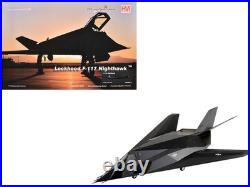
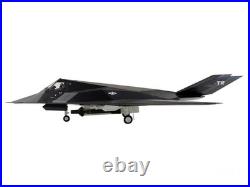
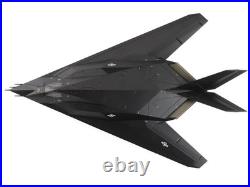
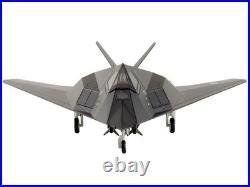
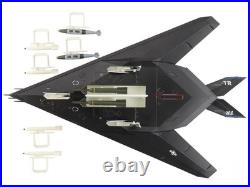
WE ONLY SELL 100% AUTHENTIC PRODUCTS GUARANTEED!! Lockheed F-117A Nighthawk Stealth Aircraft “84-0809″ (2022) United States Air Force “Air Power Series” 1/72 Diecast Model by Hobby Master. VERY RARE PIECE – HARD TO FIND – GET ONE YOURS TODAY!! EXCELLENT DEAL WON’T LAST LONG. Brand New In Plastic Wrapped! Check Out Our Other Products Listings.. Always Updating With New Products! The F-117A Nighthawk 84-0809 is one of the most iconic stealth aircraft ever developed by the United States Air Force. Designed for precision strike missions, the Nighthawk was the world’s first operational aircraft to employ stealth technology, making it virtually invisible to radar detection. Though officially retired in the late 2000s, this particular airframe, designated 84-0809, was still occasionally used in specialized training and testing roles as late as 2022. Known for its distinctive faceted shape and pioneering role in stealth warfare, the F-117A revolutionized air combat by striking heavily defended targets with unmatched precision and minimal risk of detection. During its operational career, the F-117A played a critical role in several major conflicts. It first proved its effectiveness during the Gulf War in 1991, where it carried out deep strikes against Iraqi command and control centers, air defenses, and critical infrastructure with exceptional success. Later, it participated in the NATO bombing campaign in the Balkans during the late 1990s, where its stealth capabilities allowed it to penetrate dense air defense systems to deliver precision-guided munitions. The unique loadout of 84-0809, including extra B57 and B61 bombs, indicates its capability to carry a diverse arsenal of both conventional and nuclear ordnance, emphasizing the aircraft’s strategic versatility. Even after its formal retirement from frontline service, the F-117A 84-0809 has been maintained for specialized roles, including advanced training exercises and research programs to refine stealth tactics and electronic warfare countermeasures. Its legacy as a groundbreaking aircraft that ushered in the era of stealth continues to influence modern stealth platforms. The Nighthawk remains a symbol of technological innovation and precision strike capability in the history of military aviation. This 1:72 scale model features detailed representation of its angular stealth design and unique bomb loadout, including the iconic B57 and B61 bombs. Perfect for collectors and aviation enthusiasts, this replica captures the mystique and cutting-edge technology of the world’s first stealth fighter. Display this remarkable aircraft as a tribute to one of the most revolutionary fighters in modern air combat history. Brand new 1/72 scale diecast model of Lockheed F-117A Nighthawk Stealth Aircraft “84-0809″ (2022) United States Air Force “Air Power Series” die cast model by Hobby Master. Dimensions approximately Length- 11, Wingspan- 7 inches. Diecast metal and plastic construction for durability and a heavy, realistic feel. It is a highly detailed and accurate model, perfect for collectors and enthusiasts of military history. Realistic panel lines, antennas, access panels, and surface details for an authentic representation of the real-life airplane. Items may look little different in person in terms of colors because of photography lighting. WE WILL DEFINITELY GO EXTRA MILES TO MAKE YOU HAPPY & EARN YOUR BUSINESS AND WE ASSURE YOU THAT YOU WILL BE OUR RETURN CUSTOMER. We Respectfully Ask You To Note That Once The Goods Have Left Our Premises, We Cannot Be Held Responsible If There Are Delays Caused By Situations Out Of Our Control.
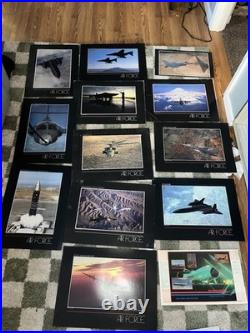
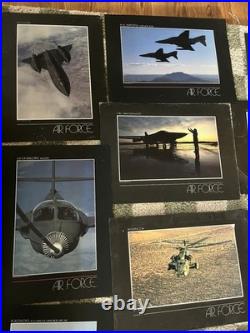
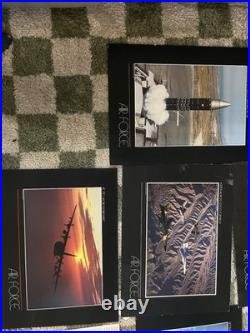
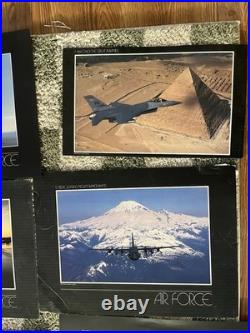
This product is a set of 12vintage US Air Force aircraft lithographs in the size of 17×23 posters. These posters feature various military aircraft used by the Air Force and would be a great addition for collectors or enthusiasts of militaria. Made in the United States, these posters are authentic and not modified, offering a glimpse into the history and technology of US Air Force aircraft.
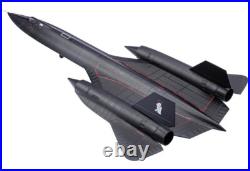
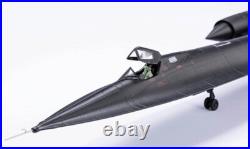
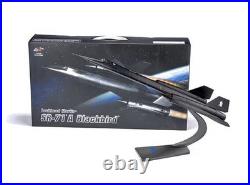
You know the part in’High Flight’ where it talks about putting out your hand to touch the face of God? Well, when we’re at speed and altitude in the SR, we have to slow down and descend in order to do that. Gil Bertelson, SR-71 pilot, in’SR-71 Blackbird: Stories, Tales and Legends,’ 2002. The Lockheed SR-71 was an advanced, long-range, Mach 3 strategic reconnaissance aircraft developed from the Lockheed A-12 and YF-12A aircraft by the Lockheed Skunk Works. The SR-71 was unofficially named the Blackbird, and called the Habu by its crews. Clarence “Kelly” Johnson was responsible for many of the design’s innovative concepts. A defensive feature of the aircraft was its high speed and operating altitude, whereby, if a surface-to-air missile launch were detected, standard evasive action was simply to accelerate. The SR-71 line was in service from 1964 to 1998, with 12 of the 32 aircraft being destroyed in accidents, though none were lost to enemy action. The Air Force ordered a reconnaissance version in December 1962. Originally named R-12, it was later renamed SR-71. The SR-71 was longer and heavier than the A-12. Its fuselage was lengthened for additional fuel capacity to increase range. A second seat was added to the cockpit and the chines were reshaped. Reconnaissance equipment included signals intelligence sensors, a side-looking radar and a photo camera. During the 1964 campaign, Republican presidential nominee Barry Goldwater continually criticized President Lyndon B. Johnson and his administration for falling behind the Soviet Union in the research and development of new weapons systems. Johnson decided to counter this criticism by releasing information on the hitherto highly classified A-12 program, and later the existence of the reconnaissance version. The SR-71 designator is a continuation of the pre-1962 bomber series, which ended with the XB-70 Valkyrie. During the later period of its testing, the B-70 was proposed for the reconnaissance/strike role, with an RS-70 designation. When it was clear that the Lockheed A-12 performance potential was much greater, USAF decided to pursue an RS-71 version of the A-12 rather than the RS-70. However, then-USAF Chief of Staff General Curtis LeMay preferred the SR (Strategic Reconnaissance) designation and wanted the RS-71 to be named SR-71. Before the Blackbird was to be announced by President Johnson on February 29th, 1964. LeMay lobbied to modify Johnson’s speech to read SR-71 instead of RS-71. The media transcript given to the press at the time still had the earlier RS-71 designation in places, creating the myth that the president had misread the aircraft’s designation. This public disclosure of the program and its renaming came as a shock to everyone at the Skunk Works and to Air Force personnel involved in the program. All of the printed maintenance manuals, flight crew handbooks, training slides and materials were labeled “R-12″; while the June 18th, 1965 Certificates of Completion issued by the Skunkworks to the first Air Force Flight Crews and their Wing Commander were labeled “R-12 Flight Crew Systems Indoctrination, Course VIII”. Following Johnson’s speech the name change was taken as an order from the Commander-in-Chief, and immediate reprinting began of new materials, including 29,000 blueprints, to be retitled “SR-71″. Pictured here is a 1:72 scale replica of a USAF Lockheed SR-71A Blackbird reconnaissance aircraft. Dimensions: Wingspan: 9-1/4-inches Length: 17-3/4-inches. Features: – Diecast construction with some plastic parts – Interchangeable landing gear options – Fully articulated control surfaces – Plexiglass canopy – Canopy opens to reveal a detailed cockpit – Accurate markings and insignia – Comes with display stand. Historical Account: “Oxcart” – In July 1964, President Lyndon B. Johnson announced the development of the Lockheed SR-71 Blackbird strategic reconnaissance aircraft. This new and advanced aircraft would give SAC a reconnaissance capability that far exceeded any then available in terms of speed, altitude, and increased area coverage. In December 1964, the Department of Defense announced that the 4200th Strategic Reconnaissance Wing would activate at Beale Air Force Base, California on January 1st, 1965, as the parent unit of the SR-71. To prepare Beale AFB for its new mission, contractors lengthened the runway, remodeled the former Air Defense Command Semi-Automatic Ground Environment building, and constructed several new facilities, including 337 additional housing units. The wing was assigned to the 14th Strategic Aerospace Division and consisted of the 4201st Strategic Reconnaissance Squadron, three maintenance squadrons and the 4203d Reconnaissance Technical Squadron. In January 1966, the first SR-71 touched down on the Beale runway. The first T-38 Talon, a Northrop-built aircraft to be used as a trainer and chase plane for the SR-71, had arrived six months earlier. In October 1965, Fifteenth Air Force suggested the 9th Bombardment Wing be redesignated as the 9th Strategic Reconnaissance Wing to continue the history of the 9th. The Air Force accepted the suggestion and on June 25th, 1966, the 4200th wing and its components were discontinued and the 9th Strategic Reconnaissance Wing transferred to Beale to take its place. The Air Force also activated the 9th Reconnaissance Technical Squadron to replace the 4203d Reconnaissance Technical Squadron. Both the 1st and 99th squadrons moved with the 9th, while the 5th inactivated. For the remainder of 1966, the 9th Strategic Reconnaissance Wing developed the organization and infrastructure necessary for SR-71 operations. The wing included a Director of Intelligence and a Director of Tests, who monitored the exhaustive testing program in the primary stages. The wing also needed its own supply squadron to handle the specialized supplies and equipment this unique aircraft would need.
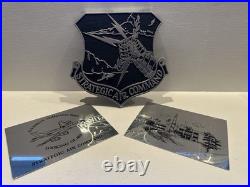
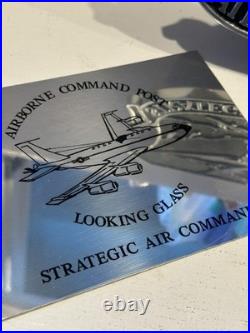
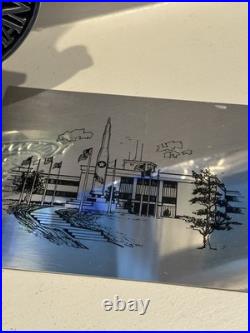
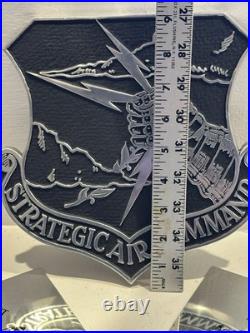
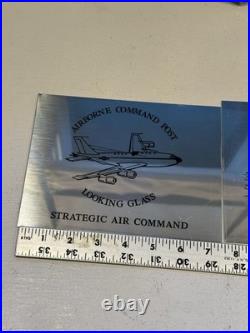
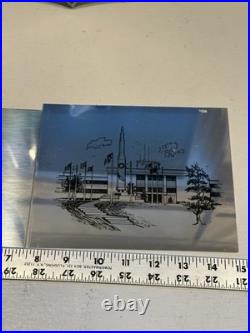
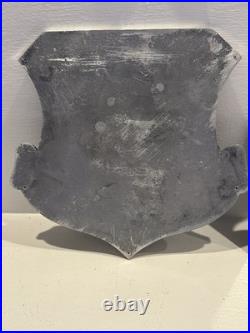
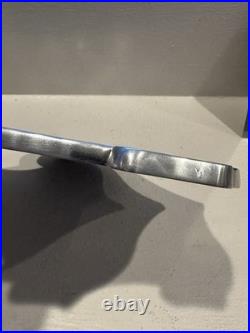
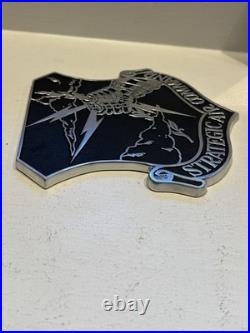
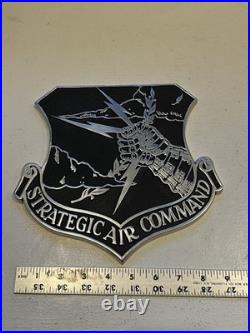
Strategic Air Command Aluminum Plaques. This set includes a thick cast aluminum plaque bearing the insignia of the United States Air Force Strategic Air Command (SAC) and two thin etched aluminum placards related to the Airborne Command Post “Looking Glass” and SAC Headquarters imagery. Design: Raised-relief emblem of the Strategic Air Command featuring the gauntleted arm clutching lightning bolts and an olive branch – symbolic of global readiness for both offense and peace. Material: Cast aluminum alloy, polished raised surfaces, with recessed black enamel or oxidized background. Dimensions: Approximately 6.5 inches wide by 7 inches high, 0.5 inch thick. Reverse: Raw unfinished casting, consistent with wall-mount plaques produced for base offices, command centers, or crew quarters. Date Range: Circa late 1950s-1970s, the Cold War operational period when SAC operated from Offutt Air Force Base, Nebraska. Airborne Command Post “Looking Glass” – Strategic Air Command. Depicts a Boeing EC-135 aircraft. Likely a desk or wall identification plate for display in command posts or briefing rooms. 7″ × 4.5″, thin brushed aluminum with black etching. SAC Headquarters Building & Missile Display. Shows the main HQ building with missile monument and flagpoles. Same etching method and size as above. Likely part of a presentation set or commemorative desk display produced for senior officers or visiting dignitaries. The Looking Glass EC-135 aircraft was an airborne command post that mirrored SAC headquarters, maintaining 24-hour readiness to direct nuclear forces in the event of ground communication failure. Plaques and etched aluminum art pieces like these were commonly produced by base machine shops or Lockheed, Boeing, or Air Force engravers as commemorative or internal presentation pieces-not mass-produced souvenirs. Authenticity Indicators: Hand-finished casting marks, non-commercial construction, period-correct aluminum thickness, and accurate heraldic design. Surviving examples typically originate from retired SAC personnel estates or base decommissioning lots. Collector Interest: Strong among Cold War, U. Air Force, and aviation memorabilia enthusiasts.
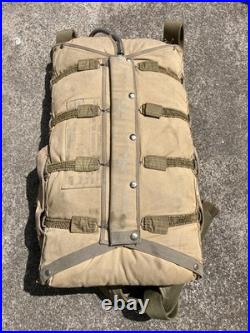
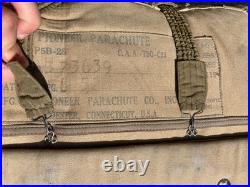
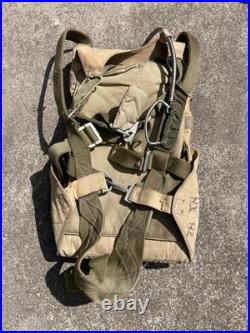
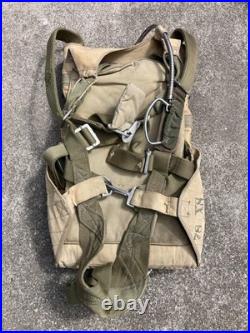
This is 70+ years old. It is not intended to be used. This is for static display only. It has its packing slip and is dated 1952. The parachute is in there. I won’t open it. It is not to be opened or used. This is static display only. Not safe for use.
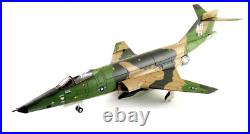
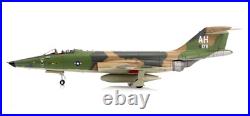
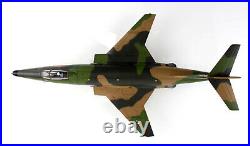
Fighter pilot is an attitude. It is a streak of rebelliousness, and it is competitiveness. But there’s something else – there’s a spark. There’s a desire to be good. To do well; in the eyes of your peers, and in your own mind. Robin Olds, Fighter Pilot: The Memoirs Of Legendary Ace Robin Olds. Using the reinforced air frame of the F-101C, the RF-101C first flew on July 12th, 1957, entering service in 1958. Like the RF-101A, the RF-101C had up to six cameras in place of radar and cannons in the reshaped nose and retained the bombing ability of the fighter-bomber versions. 166 RF-101Cs were built, including 96 originally scheduled to be F-101C fighter-bombers. On November 27th, 1957, during Operation Sun Run, an RF-101C piloted by then-Captain Robert Sweet set the Los Angeles-New York City-Los Angeles record in 6 hours 46 minutes, and New York to Los Angeles record in 3 hours, 36 minutes. Another RF-101C, piloted by then-Lieutenant Gustav Klatt, set a Los Angeles to New York record of three hours 7 minutes. The 1964 Project “Toy Tiger” fitted some RF-101C with a new camera package and a center line pod for photo-flash cartridges. Some were further upgraded under the Mod 1181 program with automatic control for the cameras. The RF-101C saw service during the Cuban Missile Crisis and soon followed the North American F-100 Super Sabres in October 1961, into combat when RF-101s from the 67th Tactical Reconnaissance Wing deployed to Vietnam. The RF-101C was deployed operationally during the Vietnam War, sustaining losses with the first F-101 being lost in November 1964 to ground fire. From 1965 through November 1970, its role was gradually taken over by the RF-4C Phantom II. In some 35,000 sorties, 39 aircraft were lost, 33 in combat, including five to SAMs, one to an airfield attack, and one in air combat to a MiG-21 in September 1967. The RF-101C’s speed made it largely immune to MiG interception. 27 of the combat losses occurred on reconnaissance missions over North Vietnam. In April 1967, ALQ-71 ECM pods were fitted to provide some protection against SAMs. Although the Voodoo was again able to operate at medium altitudes, the added drag and weight decreased the speed enough to make RF-101 vulnerable to the maneuverable (and cannon-equipped) MiGs and thus requiring fighter escort. After withdrawal from Vietnam, the RF-101C continued to serve with USAF units through 1979. In service, the RF-101C was nicknamed the “Long Bird”; it was the only version of the Voodoo to see combat. Pictured here is a 1:72 scale diecast replica of a USAF McDonnell RF-101C Voodoo reconnaissance aircraft that was nicknamed “Gerry’s Klown”, and attached to the 45th Tactical Reconnaissance Squadron “Polka Dots”, then deployed to Udorn Royal Thai Air Force Base, Thailand, during 1969. Dimensions: Wingspan: 7-inches Length: 10-1/2-inches. Features: – Diecast construction with some plastic parts – Accurate markings and insignia – Full complement of weapons – Interchangeable landing gear – Opening canopy – Comes with two seated pilot figures – Comes with display stand. Historical Account: “Polka Dots” – In August 1958, the squadron’s subsonic Thunderjets were replaced by the supersonic McDonnell RF-101C Voodoo, the first supersonic tactical reconnaissance aircraft in the USAF inventory. In the early 1960s, the United States began to become more and more involved in the ongoing conflict in Vietnam. A detachment of the squadron was sent from Japan to Don Muang Royal Thai Air Force Base, co-located with Bangkok’s international airport, in Thailand, to fly high-speed reconnaissance missions over South Vietnam. In December 1962, another detachment was deployed to Tan Son Nhut Air Base, near Saigon, South Vietnam. Its mission was to fly intelligence gathering flights. Squadron aircraft and personnel began rotational temporary duty to Tan Son Nhut, which continued until November 1965. The unit was re-designated the 45th Tactical Reconnaissance Squadron on January 1st, 1967. The usefulness of the RF-101 to the war effort was, in large part, the reason for the aircraft to remain in the inventory throughout the 1960s. Upon its return to Misawa, the squadron’s aircraft, now relatively war-weary from nearly a decade of flying combat missions, were retired and the squadron became non-operational. It was inactivated on May 31st, 1971.