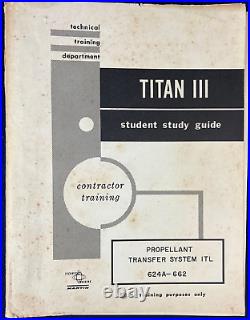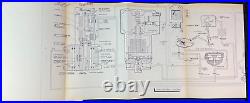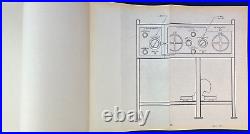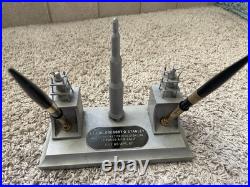
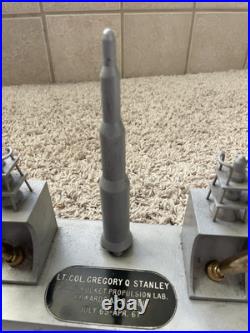
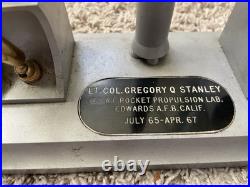
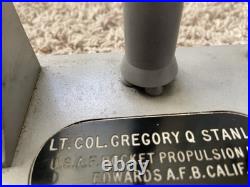
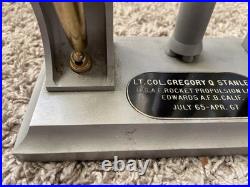
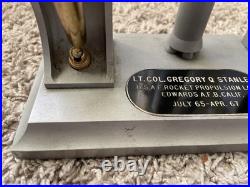
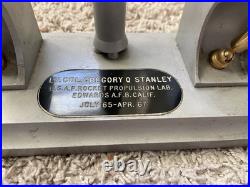
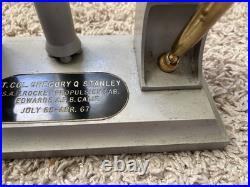
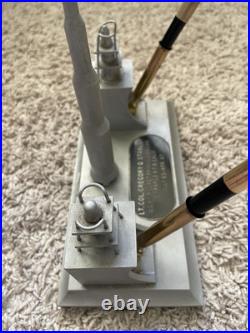
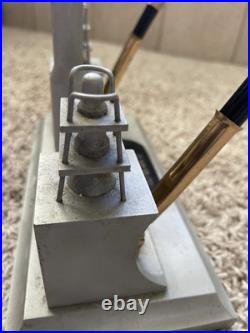
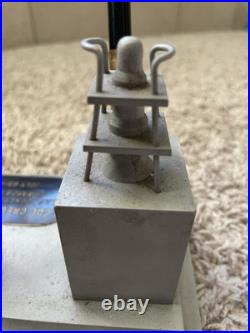
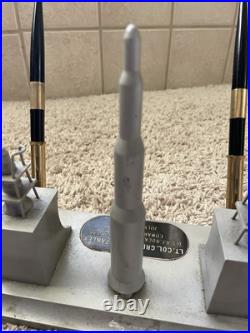
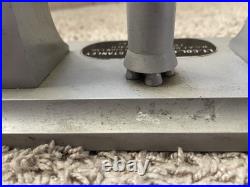
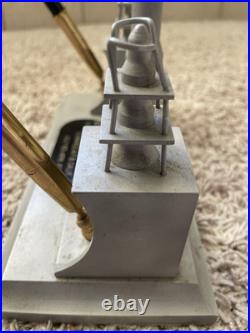
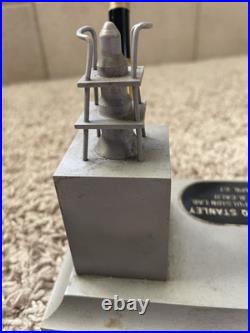
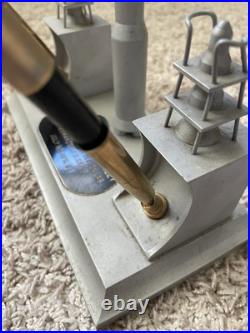
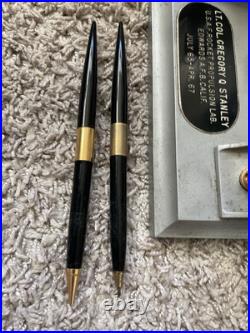
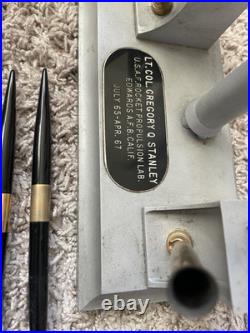
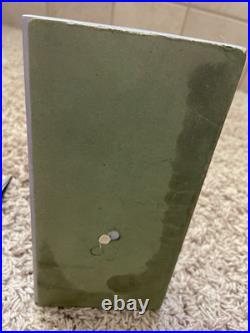
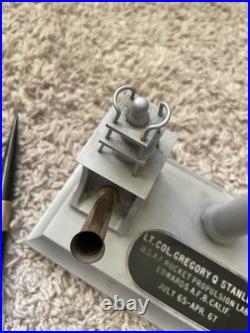
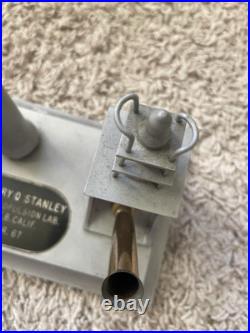

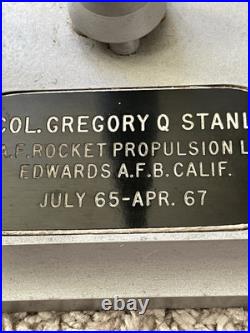
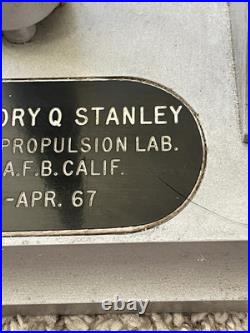

This is a one of a kind presentation piece that was hand crafted made all of metal. The pen holders and the pens are plastic but the base, the rocket in the center, and the two rocket engine stands are all metal. This measures 8″ wide x 4″ deep and the rocket measures 6 tall off the base. The name plate is well attached and in good shape. There is some discoloration on the lettering (could be cleaned but I leave vintage items as I find them). This is truly a unique collectible from a very secretive part of Edwards AFB and was from the Vietnam timeframe in history. Please review pictures provided for details of condition and ask any questions before purchasing. Read more about the AFRL below. Significance: Since its inception, the AFRL has been devoted to the advancement of rocket technology in support of U. Military weapons and space flight superiority. Unlike any other facility associated with rocket systems research, design, testing, and evaluation (RDT&E), the AFRL provided facilities for all aspects of systems development and supported some aspect of the evolution of each of the significant rocket and missile systems developed between the Cold War era and the present. Test Area 1-100 played an exceptionally important role in the development of the Minuteman missile program and in the RDT&E of performing “hot-firings” from underground missile silos. Air Force engineers at the AFRL developed the technology for achieving a successful hot-firing and designed the first silo facility in the United States that could perform this function. The ability to hot-fire the Minuteman missile was one of its most influential features because it reduced the launch time to 30 minutes or less, which put the United States on par with Soviet launch capabilities. Test Area 1-115 was the first testing facility constructed at the AFRL and was exceptionally important in the advancement of both Air Force and contractor testing and evaluation of four nationally significant missile programs and generations of intermediate rocket programs. Early tests at Test Area 1-115 of the rocket-assisted takeoff (RATO) system reflect the AFRL’s early association with the Air Force Flight Test Center, whereas later tests of the Atlas, Thor, Titan, and Bomarc programs illustrate the AFRL’s exceptionally important role in the advancement of the U. Cold War race for technological superiority. Test Area 1-125 is a unique facility at the AFRL because it originally was built for and by the National Aeronautics and Space Administration (NASA) as the F-1 production test facility. Although NASA had other testing facilities across the United States, the ability to construct three test stands capable of testing engines with 2 million pounds of thrust and use the RDT&E facilities of the AFRL proved to be a valuable asset to the success of the Apollo/Saturn V program. Test Area 1-120 provided the Air Force and industry with testing facilities that played an exceptionally important role in the advancement of nationally significant missile programs. Test Stand 1-A originally was constructed to accommodate a fully assembled Atlas intercontinental ballistic missile (ICBM). It supported that program until an accident damaged the stand’s superstructure. After the launch of Sputnik and the ensuing focus on the Apollo Saturn V program, new construction and existing facilities were turned over to NASA and Rocketdyne to perfect the E-1 and F-1 engines. The superstructure of Test Stand 1-A was rebuilt to accommodate the Rocketdyne F-1 engine, which eventually propelled the Saturn V lunar rocket. Survey number: HAER CA-236.